The Australian wool market continued to track downwards this week, recording losses for the third consecutive series.
The Australian Wool Exchange (AWEX) Eastern Market Indicator (EMI) fell back below the 2,000 cent threshold, declining by 29 cents (1.4%) for the week to close on 1,979 cents per kilo clean on Thursday 14 March. In US dollar terms, the EMI was down by 18 cents (1.3%) to finish on 1,397 US cents.
The Australian dollar against the US dollar was reasonably steady throughout the week, finishing 0.10 cents (0.1%) higher to close at 70.59 US cents on Thursday.
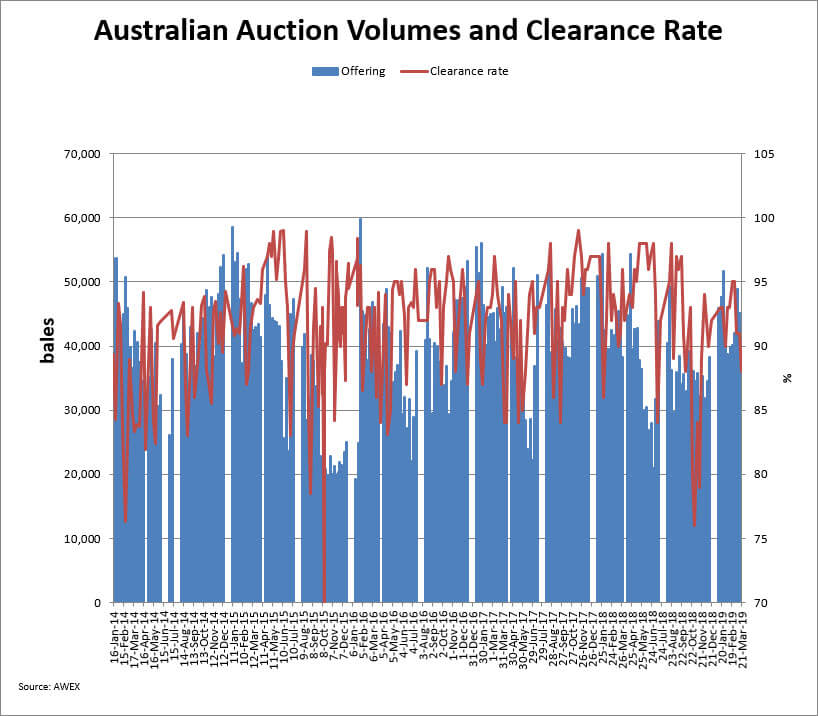
This week’s total national offering was 40,785 bales, compared with 45,130 bales last week. The clearance rate this week was 87.5% – the lowest since November, as the lower price levels were met with firm seller resistance. The clearance rate for the Merino fleece types was 86.2%.
Sales were held this week at all three selling centres on Wednesday 13 March and Thursday 14 March. On Wednesday the EMI fell by 16 cents to 1,992 cents and in US dollar terms declined by 10 cents to 1,405 US cents. On Thursday the EMI decreased by a further 13 cents to 1,979 cents and in US dollar terms fell by an additional 8 cents to 1,397 US cents.
AWEX reported that this week saw the market follow a very similar pattern to the previous series. A diminishing supply of better style wools, in particular those possessing favourable additional measurement results, attracted excellent support and closed out the week achieving prices only 15 to 20 cents below the levels achieved in the previous week.
However, AWEX noted that there was again an ever-increasing supply of lower style/lower
yielding types. The national average yield on Merino fleece types was only 63.6% dry, the lowest level in over 10 years. Buyers continually reduced their basis on these lower yielding wools, as they again struggled to average them into their purchases. By the end of the series these types were generally 30 to 50 cents cheaper. It was the large reductions in these wools which was the major factor in the average AWEX Micron Price Guides (MPGs) falling as far as they did.
Among the MPGs for the Merino types, 16.5 microns fell by 50 cents (1.9%); 17 microns was down by 54 cents (2.1%); 17.5 microns declined by 36 cents (1.4%); 18 microns decreased by 50 cents (2%); 18.5 microns was down by 33 cents (1.4%); 19 microns fell by 42 cents (1.8%); 19.5 microns lost 37 cents (1.6%); 20 microns fell by 31 cents (1.3%); 21 microns decreased by 25 cents (1.1%); and 22 microns declined by 18 cents (0.8%).
The crossbred wools, which have been performing strongly in 2019, also experienced falls across all micron ranges, with 26 to 30 microns generally 25 to 40 cents easier.
Among the average AWEX MPGs for the crossbred types, 26 microns fell by 40 cents (2.8%); 28 microns was down by 24 cents (2.1%); 30 microns decreased by 24 cents (2.6%); and 32 microns was down by 7 cents (1.2%).
Oddments prices also fell, with the average AWEX Merino Carding Indicator down by 17 cents (1.4%).
AWEX reported that the total value of the wool sold this week was AU$74.8m (AU$2,096 per bale), taking the season total to AU$2.390bn (AU$2,194 per bale). Buyers for China were dominant, with support from buyers for India and Europe.
The national offering is forecast to increase next week (Week 38) to 44,137 bales, while the projection for Week 39 is 37,340 bales and Week 40 37,186 bales.
Offerings for the next three weeks are expected to be 1.9% less than in the same period last year. The forecast progressive difference for the season as a whole up to Week 40 is 12.7% lower than the same period last season.