The Australian wool market continued its slow gradual climb this week with rises across most types.
The Australian Wool Exchange (AWEX) Eastern Market Indicator (EMI) was up by 10 cents (0.5%) for the week to close on 1,944 cents per kilo clean on Thursday 7 February. However, in US dollar terms, the EMI fell by 25 cents (1.8%) to finish on 1,380 US cents.
The direction of the movement in the EMI was again strongly influenced by movement in the exchange rate – up last week and down this week. The Australian dollar against the US dollar finished 1.69 cents (2.3%) lower to close at 70.99 US cents on Thursday, finishing at a similar level as two weeks ago. The net movement over the last two weeks is a decrease of 0.11 US cents.
Overall the market had another solid week, with strong demand. When the EMI is compared with two weeks ago, it is up in both currencies, maintaining the momentum seen since sales resumed in January. The EMI has now risen for six consecutive weeks, adding 95 cents in local currency terms since Week 24.
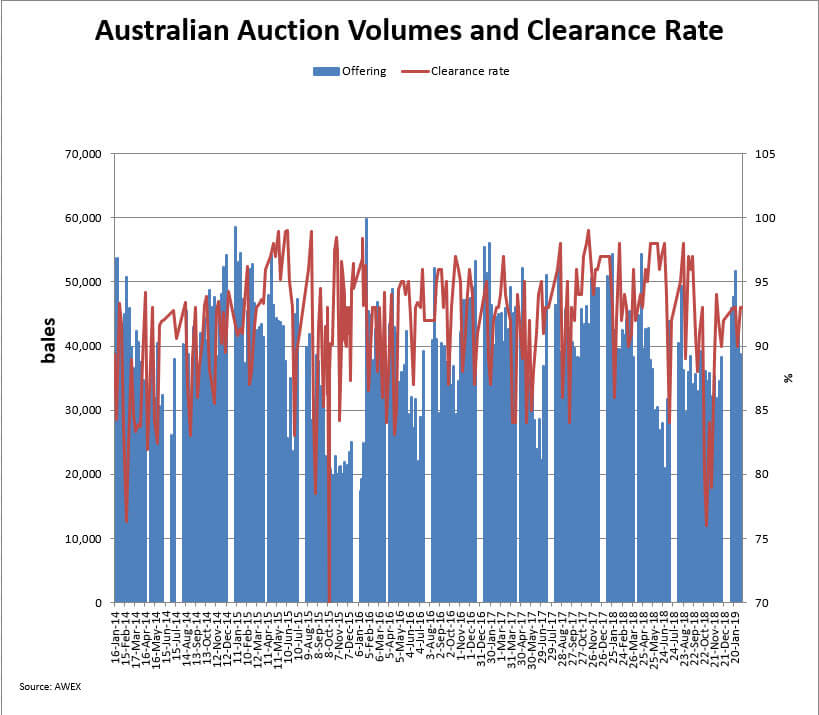
The total national offering this week was 39,894 bales, compared with 38,830 bales last week. The clearance rate this week was 93%.
AWEX reported that although quantities increased on last week, the current AWEX Four Week Forecast (FWF), which is showing a continual reduction in quantity over the coming month, has led many exporters to attempt to secure meaningful quantity while it is still available.
Sales were held this week at all three selling centres on Wednesday 6 February and Thursday 7 February. On Wednesday the EMI stayed firm on 1,934 cents but in US dollar terms decreased by 21 cents to 1,384 US cents. On Thursday the EMI rose by 10 cents to 1,944 cents and in US dollar terms declined by a further 4 cents to 1,380 US cents.
AWEX reported that while prices remained relatively unchanged on the first day of selling, on the second day buyers became more aggressive in their approach, resulting in price increases across the board. The prices being realised were generally 10 to 20 cents above
those achieved last week.
This week saw the first designated Superfine sale in the Northern region. The specialty selection attracted strong support, pushing the average AWEX Micron Price Guides (MPGs) for wool of 18 microns and finer up by 40 to 45 cents.
Overall, changes in the MPGs were similar across the Merino wools, apart from a greater lift at 24 microns. 16.5 microns rose by 9 cents (0.4%); 17 microns was up by 10 cents (0.4%); 17.5 microns gained 6 cents (0.2%); 18 microns increased by 16 cents (0.7%); 18.5 microns was up by 5 cents (0.2%); 19 microns increased by 13 cents (0.6%); 19.5 microns gained 9 cents (0.4%); 20 microns lifted by 10 cents (0.4%); 21 microns increased by 20 cents (0.9%); 22 microns rose by 10 cents (0.5%); 23 microns climbed by 10 cents (0.4%); and 24 microns rose by 28 cents (1.5%)
The crossbreds again generally did better than the Merinos, but by a much smaller margin than last week. General increases of between 20 and 40 cents were experienced in the 25-30 micron range. A limited selection of 32 microns was generally unchanged. The strongest performances occurred at 28 and 30 microns, as was the case last week.
Among the average AWEX MPGs for the crossbred types, 25 microns rose by 10 cents (0.7%); 26 microns climbed by 4 cents (0.3%); 28 microns rose by 21 cents (2%); 30 microns increased by 40 cents (4.7%); and 32 microns was up by 2 cents (0.4%).
The oddments market finished marginally easier, with most types generally down by 5 to 10 cents. Oddments were easier on Wednesday, but recovered most of the falls on Thursday.
AWEX reported that the total value of the wool sold this week was AU$77.2m (AU$2,081 per bale), taking the season total to AU$1.966bn (AU$2,205 per bale). Buyers for China were dominant, with support from buyers for India and Europe.
The offering for next week (Week 33) is forecast to be 39,520 bales, with the projection for Week 34 38,205 bales, and Week 35 – a designated Australian superfine sale – 35,275 bales.
Offerings for the next three weeks are expected to be 12% less than in the same period last year. The forecast progressive difference for the season as a whole up to Week 35 is 15% lower than the same period last season.