Hybrid polymeric amyloid proteins that can be spun into fibres that are stronger than spider silk have been designed by researchers at Washington University in St Louis (US). Jessica Owen reports.
It is well known that spider silk is one of the strongest and toughest materials in the world. In fact, this impressive natural characteristic has inspired many researchers over the last few decades to recreate it artificially. But while both companies (eg Spidey Tek) and academics have developed artificial spider silk to some extent, it is extremely difficult to reproduce it to the same tensile strength and toughness of the natural material.
That said, researchers at Washington University in St Louis (US) think they have found the answer: using amyloid peptides (structural proteins) to create hybrid polymeric amyloid proteins (essentially, where dozens or even hundreds of amyloid peptides are connected together) that can be spun into fibres with enhanced strength and toughness properties.
“The design strategy and the biosynthetic approach can be expanded to create numerous functional materials and the macroscopic amyloid fibres will enable a wide range of mechanically demanding applications,” the researchers say, noting that these could include apparel and military wear.
To create this new artificial silk, the researchers needed to create β-nanocrystals, a main component of natural spider silk, which contributes to its strength. To do that, the team redesigned the silk sequence by introducing amyloid sequences that have high tendency to form β-nanocrystals.
Specifically, the researchers started with amyloid peptides and connected them with flexible glycine-rich linkers (elements that help link proteins together to create more stable interactions) from spidroins (the main proteins found in spider silk). Using genetic engineering, the amyloid proteins are then biosynthesised (converted into a compound) in engineered bacteria, purified, and then prepared for spinning. During the wet-spinning process, the amyloid peptides then fold into β-sheet crystals well-aligned with fibril axis, creating mechanical strength at the macroscale.
The resulting proteins have less repetitive amino acid sequences than spider silk, making them easier to be produced by engineered bacteria. And ultimately, the bacteria produced a hybrid polymeric amyloid protein with 128 repeating units – an achievement that has proven to be difficult until now, according to the researchers.
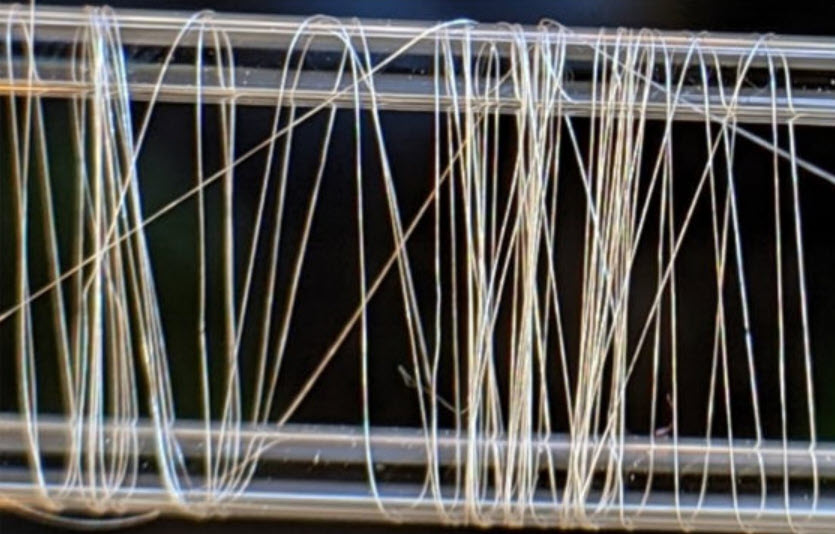
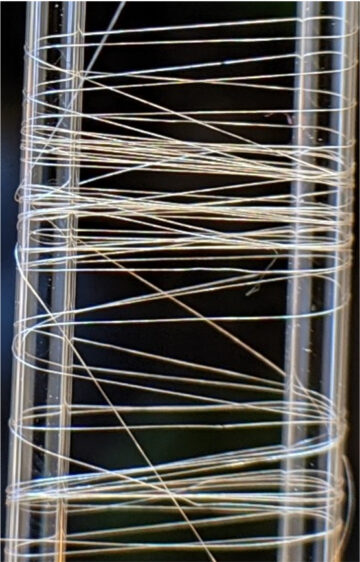
The 128-repeat proteins resulted in a fibre with gigapascal strength (a measure of how much force is needed to break a fibre of fixed diameter), which is stronger than common steel. The fibres’ toughness (a measure of how much energy is needed to break a fibre) is higher than Kevlar and all previous recombinant silk fibres. What’s more, its strength and toughness are even higher than some reported natural spider silk fibres, the team says.
These new proteins and the resulting fibres are not the end of the story for high-performance synthetic fibres for the team. There are now a few more challenges that need solving, including expense and scale.

“The method is not scalable, but we are working on it and hopefully one day it will become commercially competitive,” says Fuzhong Zhang, a professor in the Department of Energy, Environmental & Chemical Engineering in the McKelvey School of Engineering at Washington University.
“My group is working on a few directions, exploring new sequences that have better performance characteristics, and exploring scalable and cheaper processes.”
The research was published in the ACS Nano journal.