Otis Robinson speaks with Taiwanese original equipment manufacturers (OEMs) Pailung, Asia Kingdom, Acme and Kaeuo Heng about automation in the region’s textile industry.
In Taiwan, there is a drive for the use of automation in its textile industry. This is down to three key factors: government policy, brand request and a shortage of labour, says Asia Kingdom Machinery Co, a company that provides fabric dyeing machines for big-name brand companies.
Steven Lin, managing director at the company, explains that, first and foremost, the Taiwanese government has placed a lot of emphasis on automation and smart production, coordinating many seminars and projects with the Taiwan Textile Research Institute (TTRI) to develop new, Industry 4.0-focused automation technology. Secondly, brands demand advanced processes that can decrease negative environmental impact. And finally, a shortage of labour due to the ongoing Covid-19 pandemic has led to a decline in productivity – simultaneously, a ‘pivotal push’ from customers has led to perseverance from businesses, leading many to consider automated machinery as a replacement to the traditional factory floor worker to keep things running smoothly.
What’s more, the development of automation technologies from leading original equipment manufacturers (OEMs) such as Asia Kingdom suggests the Taiwanese industry is fast to adapt itself to key concerns of its market.
In a previous report on Taiwan’s OEMs for WTiN’s Textile 4.0 journal, TAITRA (the Taiwan External Trade Development Council), a non-profit, government co-sponsored, trade promotion organisation, explored how Taiwan’s use of high-concept automation machinery has helped it adapt to and remain resilient in the face of the ongoing pandemic. Thus, the developments visible in Taiwanese textile automation machinery plot the East Asian country as an emergent strong player in the Industry 4.0 space.
Automation as a solution
Primarily, as in its nature, automation is used as a solution to longstanding industry issues in the Taiwanese textile market.
Pailung, a provider of circular and flat knitting machines for the textile industry, posits smart knitting, which uses automation and smart monitoring, as a solution for existing problems in the textile industry. Mason Chao, assistant manager, marketing department at Pailung, says most circular knitting machines use smart technologies like data management systems to manage the machines, whereas Pailung is interested in controlling their automated processes too. According to Chao, this will help the global industry – not only Taiwan – to cope with a decline in manpower, recruitment and training.
Elsewhere, in Taiwan specifically, the use of automation is linked closely to its position in the global market and the ways it can raise its competitive angle. Chi-Lung Chang, managing director at Acme Machinery Industry Co, another Taiwanese OEM for the textile dyeing sector, says that compared to other large fabric production countries, Taiwan does not have access to inexpensive production and labour, meaning many textile businesses moved abroad to tap into low wages, land and low production costs. For Taiwan’s industry to survive this wave, Chang believes the automation of production is the way forward.
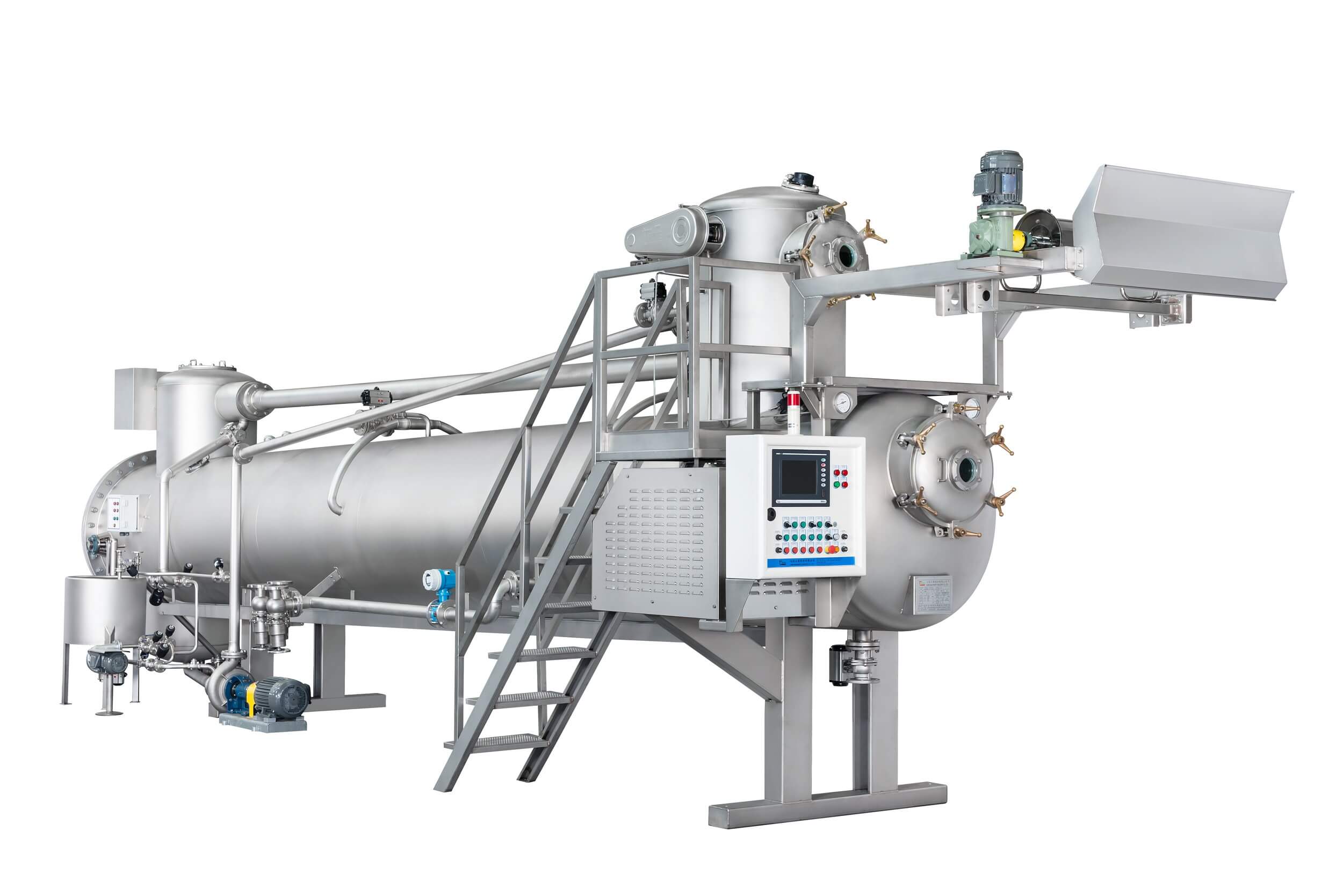
The company additionally says that the key to increasing Taiwan’s competitive angle is the use of automation to push environmentalism. Acme Machinery recently launched the AM-ICD, a high pressure, constant speed dyeing machine with an intelligent conveyer – Chang says the machine is fully automatically controlled, which helps to eliminate operator errors, record valuable process data and improve chemical control. Conventional dyeing machines require a lot of water to circulate fabric, but technology such as Acme’s AM-ICD machine utilises a conveyor to do so. By focusing its R&D on compact automation and the environment, the company hopes to help the industry battle its “very serious problem with regards to water and energy usage”.
“The dyeing industry is not only one of the biggest consumers of water and energy, but also one of the biggest polluters,” Chang says. “By using new generation dyeing machinery, it can save water, energy, wastewater and CO2 emissions can be reduced.”
Thus, by wielding automation in the textile manufacturing supply chain, Chang says dyers can hit two birds with one stone: “Innovation does not only highly reduce the production cost, but also helps solve the environmental problem.”
Asia Kingdom has too explored the use of advanced technologies in the Industry 4.0 space, powered by similar motivations – Lin says the company has recently developed a new fabric washing technology that utilises artificial intelligence (AI) to observe, improve, optimise and gather data on the process.
“We digitalised the whole fabric washing process. It becomes a fully automated process controlled by AI,” explains Lin. “It also reduces water usage on an average of 30% for our customers.”
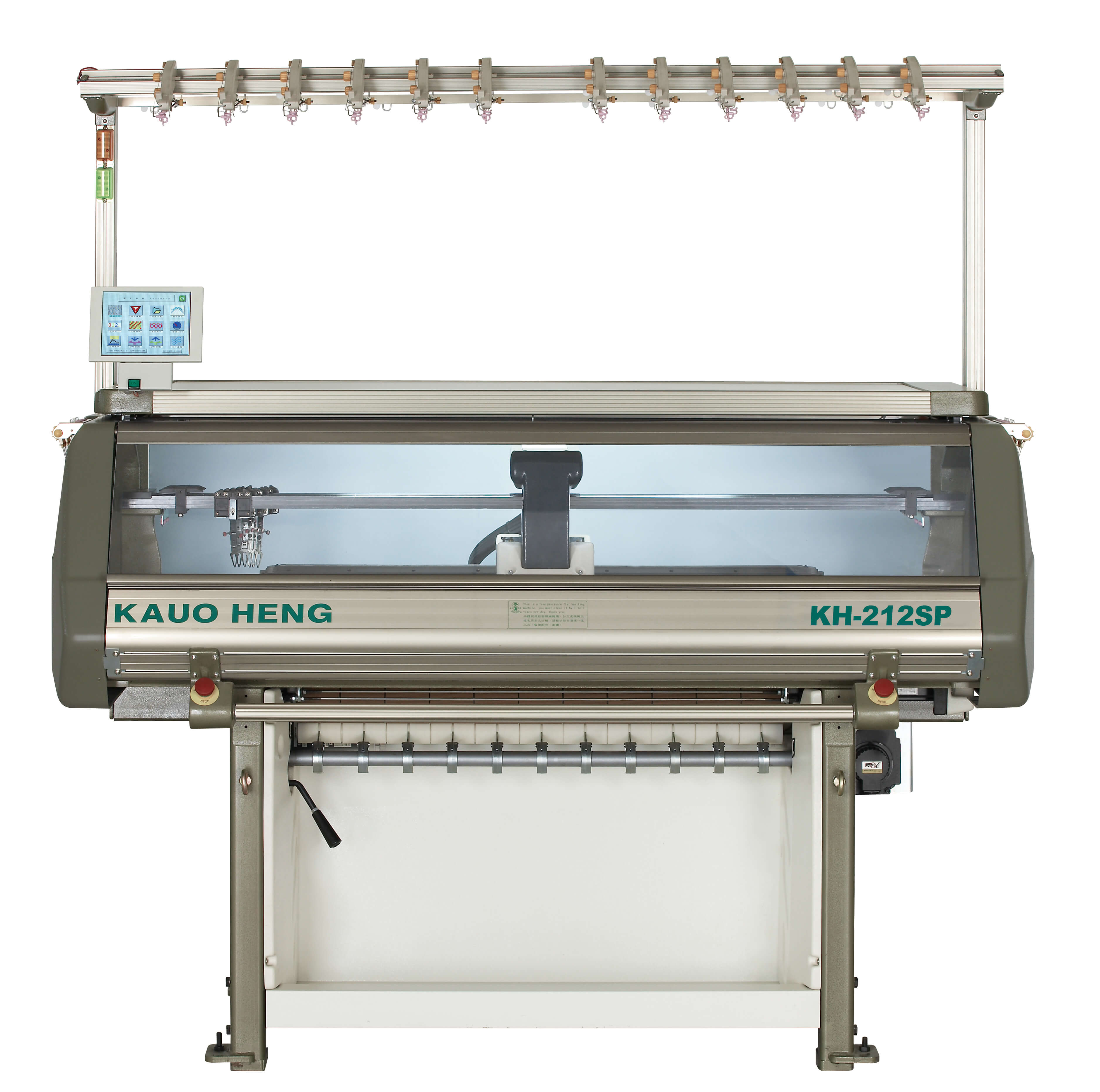
Elsewhere, Kauo Heng Company, a manufacturer of computerised flat knitting machines, is focusing on a new machine – the KH-212SP – to increase production and enable the reduction of traditional energy consumption patterns. The machine uniquely adopts a newly developed needle selection system: this double-V-style system helps to shorten the knitting process while using less electricity to reduce energy consumption.
During these interviews with Taiwanese OEMs, a common theme makes itself clear: in Taiwan there is also an increased focus on wielding Industry 4.0 to address environmental damage.
Innovation
All four interviewees express the belief that automation is somewhat of a silver bullet. Albert Ho, sales manager at Kauo Heng, says that automation has not only offered some steppingstone environmental benefits, but also greatly increased the country’s productivity, provided incredible data for better management, and enabled cost and profit control.
“The use of automation in the Taiwanese textile industry has become more and more important,” Ho says, and adds that the industry must continue to push for innovation in automation to compete with neighbouring China and meet new missions from customers.
Consequently, Lin predicts that the future of the Taiwanese textile industry will be fast, small lot production and speedy delivery. This is likely because major brands are moving towards the prioritisation of online sales, says Lin, coupled with new innovation and technology adoption.
Lin also predicts that the future of the Taiwanese textile industry will feature textile mills that have digitalised: “You will see very few workers on the factory floor and lots of sensors and highly automated machinery working. The human engineers will be working more on solving new and creative problems than carrying out old and routine issues.
“The factory will focus on small lot production and will be very environmentally friendly.”
Chang concurs, explaining that he believes the future of the Taiwanese textile industry will rely on high quality but a small amount of diverse production.
Ho concludes: “Automation can do even more, as long as there are demands in the market.”